
As another year draws to a close, I am shocked to realise that I have not blogged on here since July! As I have no chance of ever catching up on reviewing all the books I have read since then, I thought it would be easier to do a quick listing. I shall then be able to start 2011 with a (nearly) clean sheet!
In a Dry Season by Peter Robinson
Not much to say about this book - Peter Robinson is one of my favourite crime writers and I always enjoy his Inspector Banks novels - but I must just comment on the recent TV adaptation. While I was thrilled to finally see Inspector Banks as a TV drama I was disappointed not only by the casting of Stephen Tompkinson in the lead role, but also in their jumping in at book number 12 (especially as it wasn't one I have read!) I have nothing against Stephen Tompkinson as an actor, but I didn't feel he was right for the role. Also, by jumping in so late in the series, we missed out on getting to know and understand Alan Banks - his background, his morality and even his personality. I think I would have enjoyed the TV version, had I not already been such a fan of the novels.
Among the Bohemians: Experiments in Living 1900-1939 by Virginia Nicholson
My favourite sort of non-fiction book - one that reads almost like a novel with a wonderful cast of interesting and diverse characters. A perfect 'jumping-off point' for anyone interested in this era.
The Children's Book by A.S. Byatt
I have never read any A.S. Byatt before, despite having Possession on my bookcase for several years now. The Children's Book had appealed to me because of it's Bohemian setting (having not long read Among the Bohemians by Virginia Nicholson) and I loved the allusions to real life characters from the world of literature and art of the time. The world Byatt creates is magical and the way the story moves from character to character while never becoming bogged down or too complex is indicative of her great writing talent. On the downside, it is an overly long book and I did feel that it could have done with more aggressive editing.
Stone's Fall by Iain Pears
This is the second novel I have read by Iain Pears - the first being An Instance of the Fingerpost. Strangely I could probably write the same comments for both: an interesting and unique plot, fascinating characters, well drawn and with great period detail. And yet...both books seem to lack something and I am not quite sure what it is. I enjoyed the story, I cared about the characters, but I found it difficult to read - not because of the prose, more because of a lack of impetus. The plot could be plodding and slow-moving in parts. For once, I almost wished there was a TV or film adaptation that I could watch, rather than reading the book.
The White Queen by Philippa Gregory
Another thoroughly enjoyable historical fiction from Philippa Gregory. She has moved back from the Tudor age now and this is the first in her trilogy about the Plantagenets. Elizabeth Woodville is the central character of this novel and is written as a strong and admirable female character with a strong sense of loyalty and family. Not being a history scholar I cannot really comment on how historically accurate the plot and characterisation are, but what I love about these novels is that they arouse your interest in the subject matter.
Bess of Hardwick by Mary S Lovell
Fascinating and very readable biography. Having visited and loved Chatsworth as well as devouring Lovell's biography of the Mitfords, this was a perfect book choice.
David Blaize by E F Benson
The only Benson I had read before were the Mapp and Lucia books, which are wonderfully observed and subtlely humorous. David Blaize gives you more of the same, this time set in a boys' boarding school.
Good Behaviour by Molly Keane
Aroon St Clare is an absolutely wonderful comic character and this story follows her stumbling from one social faux pas (including the almost-accidental murder of her mother) to another, all in the name of 'Good Behaviour'. I adored this book and will certainly be reading more Molly Keane in the future.
The Princes in the Tower by Alison Weir
Having read The White Queen by Philippa Gregory I was keen to learn more about Edward V and his brother Richard, Duke of Gloucester. Alison Weir is very readable and accessible - her books feel learned and scholarly without being fusty and exclusive. Whether I agree with her conclusion that Richard III was responsible for the princes' murder I am still not sure, although it seems there is no other viable explanation.
Rabbit Run by John Updike
Not really my kind of novel, and certainly not what I would normally read, but I had heard such great things about John Updike that when I found a copy of this is my local charity shop I thought I would give it a go. I'm so glad that I did - this is a really wonderful book, both comic and tragic in equal measures and with an anti-hero that you cannot help but empathise with.
The Present and the Past by Ivy Compton-Burnett
Again, this was an author I had never read, but had heard about through other book bloggers and so picked up a second-hand copy in a charity shop. I am ashamed to admit that I didn't finish this book (I very rarely give up on books - in fact, I would say this is one of only three or four books I have ever cast aside) - I found it far too rambling and without direction. The language, and indeed most of the characterisation, seemed unrealistic and I just had no interest in what the characters would say next, or what would happen to them. One review on Amazon says that Ivy Compton-Burnett is an acquired taste - based on this novel, I wholeheartedly agree!
The Fry Chronicles by Stephen Fry
I adore Stephen Fry and I have to admit that there are very few ways in which this book could have failed to please me. Telling the story of Fry's escape from a delinquent adolescence to Cambridge University there are celebrity anecdotes and plenty of soul-searching from Fry as he tries to understand and explain his addictive personality and his drive for fame. It ends with Fry on the brink of National Treasure-dom and hints at an impending cocaine addiction. Fascinating, honest and written with humour and candour I loved every page of this biography.
Friday, 31 December 2010


Tuesday, 27 July 2010
Middlesex by Jeffrey Eugenides

Middlesex by Jeffrey Eugenides is one of those books that it felt like everyone except me had read. You know, the one that all the commuters seem to be reading and that you see in charity shops by the bucketful. I was therefore quite pleased when this got suggested as a book club read. I hadn't even realised it was by the author of The Virgin Suicides which I had read and loved a year or so ago.
The great thing about this book was the number of ways in which I enjoyed it. It had the sweeping family saga (three generations!), the undiscovered secret and romance. With all of that in one story it is no wonder it has been enjoyed by so many people. The writing style is easy, straight-forward and familiar and while not comic in the traditional sense, there are certainly amusing incidents.
The great thing about this book was the number of ways in which I enjoyed it. It had the sweeping family saga (three generations!), the undiscovered secret and romance. With all of that in one story it is no wonder it has been enjoyed by so many people. The writing style is easy, straight-forward and familiar and while not comic in the traditional sense, there are certainly amusing incidents.
For such a chunky book, this was an incredibly quick read. Although there was no real mystery in the novel, I felt I had grown to know the narrator so well that I wanted to find out how everything ended up, like listening to a friend telling you their family history, warts and all. It's a really delightful book, despite, or perhaps because of, its unusual subject matter.
Friday, 23 July 2010
Clara Reeve by Leoni Hargreave

Clara Reeve by Leoni Hargreave was given to me by my brother-in-law who is a literary fanatic, with a book collection that could probably put the British Library to shame. His main area of interest however is science fiction, so I was very surprised when he gave me this book, of which he mistakenly had two copies. So, how does a sci-fi enthusiast end up with not one but two copies of a Victorian pastiche novel? Well, Leonie Hargreave is a pen-name, which the author Thomas M Disch was advised to use when publishing this novel which was so different to his usual output of science fiction work.

As a fan of all things Victorian, I was absolutely delighted and couldn't wait to get reading. With the background knowledge of the book being written by a) a man and b) a sci-fi author I was very much prepared for the worst. Thankfully, I was pleasantly surprised. Hargreave/Disch really managed to evoke the sensation novels of the Victorian era and all the trademarks are there - the mysterious continental man-servant, the mentally unstable wife, the question of inheritance and a dark secret bubbling under the surface. The period detail is well created and it really felt quite authentic, perhaps even so far as it being quite a verbose and hard-going book at times. The main character of Clara is endearing and sympathetic - all her troubles are visited upon her for no apparent reason other than an accident of her birth; very much a case of being in the wrong place at the wrong time. What I did find frustrating was that the denouement was so late in the book and consequently, I felt, a bit rushed.
Not one of the most memorable Victoriana novels I have ever read - it's no Fingersmith or The Crimson Petal and the White (which also was rather a departure from the authors usual subject matters and writing style) but I like to think it was one of the more authentic and unusual.
The End of the Affair by Graham Greene

It wasn't what I had expected (although I'm not really sure what that was) but I did enjoy reading it. The narrator is a fairly unlikeable fellow, I thought, and through his eyes we see his and the woman's lives beginning to unravel as their affair begins, ends and resumes. He is a rather arrogant and selfish man who seems to have little regard for the effects of his actions on others. The woman is an interesting character - self-serving yet not selfish, pleasure-seeking yet not vacuous. For a book by a male author it is quite a surprising depiction of how women of the time were looking to create lives and interests of their own and how they tried to balance being a wife whilst maintaining their sense of self.
The most unexpected part of the novel for me was the exploration of faith and Catholicism. I had expected some intrigue, but not along the lines of whether someone believed in God or not, and the effect that had on those around them.
It's not a book I would jump to recommend, but it is an interesting examination of love, it's power (both for good and for bad) and how very differently people choose to live their lives in pursuit of happiness and fulfilment.
Sunday, 18 July 2010
Brooklyn by Colm Toibin
 Having read Wolf Hall for our last book club we all agreed that Brooklyn by Colm Toibin seemed like a good 'easy read' choice for our next book. It was the winner of the 2009 Costa Novel award and longlisted for the Man Booker 2009 and so we had high expectations. The story is of a girl from a small town in Ireland who moves to Brooklyn to start a new life and follows her experiences there. Whilst we all thought it would be quite a light read, I think we were all surprised by just how light it turned out to be. The one male in our book club felt he had been duped into reading a chick-lit novel and, much as it pains me, I tend to agree with him. What we all felt it lacked was any depth, any real emotional tie and, indeed, any real point. I didn't feel I had learnt anything at the end of the book. The emotions and plot were all things I have read before and I failed to find anything 'novel' about it all. Few of the characters seemed likeable. Plenty of opportunities for interesting storylines seemed to be passed over (the department stores attitude towards black customers for example) and neither of the love interests fitted my idea of a romantic hero.
Who knows, perhaps we all missed the point of this book? In its defence, it is a very easy read and you do get swept along in the story. It's just that I constantly had the sense of waiting for something to happen, for a plot development that never really came. The dramatic incident that brings Eilis back to Ireland even felt to me a bit underwhelming and skimmed over. Maybe I'm too big a fan of melodrama - what do you think?
Rebecca by Daphne du Maurier

And it was.
The atmosphere, the palpable sense of dread and uncertainty throughout the story and the pace of the plot make it a true page-turner. What I found most interesting was the almost supernatural sense that du Maurier creates. As I said, I knew nothing about the story and I was kept guessing right the way through. I thought that Mrs Danvers could be Rebecca, or that all the other characters were ghosts. The twists and turns in the plot don't feel like twists and turns - they all make sense and are perfectly possible. Somehow the fact that none of it was supernatural made the whole thing seem more sinister.
Love from Nancy: The Letters of Nancy Mitford
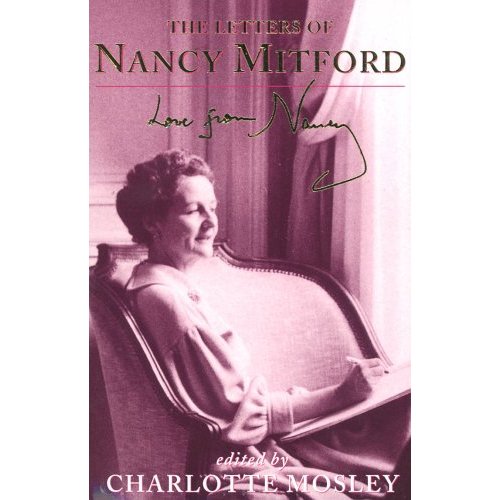
A wonderful insight to a wonderful lady - this collection is well worth reading. I had it on my bedside table for some time and found it perfect to dip in and out of when no other reading material seemed to be the right choice.
Subscribe to:
Posts (Atom)